Thursday, November 14, 2013

Testing Procedures


Testing Type: Exploratory

Testing Stage: Preliminary

Sate of Solution: Not Constructed/Materials Selection

Condition of Testing Stage: Elevation- Sea Level to 150 feet above sea level.

Tools and Equipment Required: Styrofoam insulation, band saw, scale

5 Months Before Launch: Weigh Approximate Materials

1.       Cut materials to approximate size as directed by CAD drawings.

2.       Weigh each cut material piece.

3.       Record data for weight of Styrofoam material.


Testing Type: Exploratory

Testing Stage: Preliminary

Sate of Solution: Not Constructed/Materials Selection

Condition of Testing Stage: Elevation- Sea Level to 150 feet above sea level.

Tools and Equipment Required: Bolts, nuts, camera equipment, petridishes

5 Months Before Launch: Weigh Approximate Materials

1.       Gather internal equipment.

2.       Fill petridishes with water.

3.       Weigh all internal materials.

4.       Record data for weight of internal material.


Testing Type: Exploratory

Testing Stage: Preliminary

Sate of Solution: Not Constructed/Materials Selection

Condition of Testing Stage: Elevation- Sea Level to 150 feet above sea level.

Tools and Equipment Required: Plexiglass sheet, band saw, scale

5 Months Before Launch: Weigh Approximate Materials

1.       Cut materials to approximate size as directed by CAD drawings.

2.       Weigh each cut material piece.

3.       Record data for weight of plexiglass material.


Testing Type: Validation
Testing Stage: Preliminary
State of Solution: Designed and ready to construct.
Condition of Testing Stage: Elevation-Sea Level to 150 feet above sea level.
Tools and Equipment Required: Probe hull, petri dishes filled with water, tall building.

4 Months before Launch: Test Hull Durability During Landing

1.       Fill petri dishes with water.

2.       Assemble probe hull.

3.       Insert petri dishes into probe hull.

4.       Carry probe to the top of building approx. 150 feet.

5.       Drop probe body from building.

6.       Check results.

7.       Repeat steps 1-4 except this time attach the parachute to the probe.

8.       Drop probe.

9.       Check results.


`

Testing Type: Validation

Testing Stage: Preliminary

State of Solution:  Petri Dishes Assembled

Condition of Testing Stage: Elevation Sea Level

Tools and Equipment Required: Petri dishes, water, tardigrades

4 Months Before Launch: Test Petri Dish Holding Capabilities

1.       Fill petri dishes with water.

2.       Insert 10 tardigrades into water.

3.       Seal petri dishes as planned.

4.       Invert petri dishes .

5.       Leave petri dishes for 4 hours.

6.       Empty petri dishes and count tardigrades.

7.       Adjust sealing method or containment method as needed to preserve tardigrades.


Tuesday, October 22, 2013

Rationale

Rationale Report

Alternate Solution 1: Compact Rectangular Probe

Introduction:
This solution features a small rectangular probe body. The body is vertically divided into two compartments. The left side being the expose tardigrade containment area, while the right being an enclosed electronics compartment. The internal pieces of the probe are accessed through hatches on the top of the probe.

Pros:
This design is extremely small. This means the probe will weigh much less than other designs allowing us to lift the balloon to higher heights. This design would also use less materials and be cheaper than some of our other designs.

Cons:
This design makes it difficult to access the tardigrades and electronic equipment due to the small hatches. Also the tardigrade exposure area is not as exposed as some of the other solutions. This design only has holes in the top while others are completely mesh.

Conclusion:
This solution is effective and cheap, but perhaps not the most accurate from a science perspective, and also not the easiest to access the interior.

Alternate Solution 2: Soyuz Style Probe

Introduction:
Much larger and heavier than solution one. The Soyuz Style solution features landing legs and a large square body with a horizontal division of compartments. The top compartment would be for electronics, while the bottom would be for the tardigrade containment.

Pros:
This solution is extremely safe during landing. The legs would protect the internal equipment in the probe. The areas for electronics and tardigrades are also much larger than in the first design. 

Cons:
This design is very heavy. The landing legs are basically dead weight for the balloons to lift. This would prevent the probe from reaching its maximum altitude.

Conclusion:
This design is low risk but a very high weight. This could compromise our science experiment because the probe may not reach a maximum height. This design requires more materials.

Alternate Solution 3:

Introduction:
This solution makes use of the fact that triangles are the strongest shape in nature. This probe uses the triangle idea to gain strength for landing and launch.

Pros:
The strength of this probe is definitely a positive feature. It also would require less materials due to its shape and less surface area.

Cons:
The clear con of this design is the loss of space due to the triangular shape. This means Connor Varley's cameras would be jam packed into the top point. We may even have to leave a camera out if we use this method.

Conclusion:
This design though strong and cheap makes it hard for us to use the amount of equipment we had originally planned.

Alternate Solution 4: Mesh Exposure Probe

Introduction:
This solution is a simplistic shape. The probe features a large area for both tardigrades and electronic equipment as well as a mesh exposure area for the tardigrade containment. The probe is horizontally divided with hatches on the sides to gain access to the interior.

Pros:
This solution best exposes the tardigrades to the elements. It has plenty of room for both the electronics and the tardigrades. The larger hatches allow easier access to the interior. The probe can be scaled to fit as little or as much materials we need to carry.

Cons:
This device uses a moderate amount of materials. The probe is a simplistic shape and lacks aesthetics.

Conclusion:
 
This probe design is possibly the best we have. The probe exposes the tardigrades exceptionally well and allows us to keep as much equipment in the hull as we need. The probe is also and easy shape to construct.

 
Final Choice:
I have chosen the Mesh Exposure Probe as the best design. The design wins out in the design matrix as it scores 26 and the second best (Triangle Probe) was not chosen because it does not have enough room for Connor's electronic equipment. The selected probe also exposes the tardigrade exceptionally well as it has numerous holes compared to the other designs. This design also features less angles and will allow us to construct the system with relative ease. This system however was altered slightly as we will no longer be using mesh. This is because to maintain structural integrity it is beneficial to have a solid bottom with holes drilled into the sides. The doors to this probe will also be sealed using insulation tape and dowels. The probe hull will be structurally supported by plexiglass sandwich sheets bolted together as shown in my 2D orthographic. This will keep all of the sections together and allow the balloon and parachute to be attached firmly to the probe.

Friday, September 27, 2013

Project Stratobear Introduction

Introduction:

Project Stratobear is a senior project for three students at The Marine Academy of Science and Technology. The project will center around the goal of studying the upper atmospheric effect on Tardigrades (Waterbears). A Tardigrade is a small water dwelling micro-animal with six legs which have been hypothesized to have come from outer space. The Tardigrade is an extremophile which means it can survive in extreme conditions of heat and cold. The project involves constructing a weather balloon probe that would mimic the atmospheric effects of space to Earth entry.


Because of our project's diverse needs our group has chosen to split up the work and specialize in different areas:

Joseph Nardone- Team leader and probe housing engineer. The design challenge he will face is designing containment that will not only hold the Tardigrades into a specific area, but will also expose them to the atmospheric environment.

Nate Librizzi- Launch and recovery engineer. The design challenge he will face is designing a method to return the probe not only slowly, but also upright to preserve the Tardigrade containment.

Connor Varley- Navigation and camera operation engineer. The design challenge he will face is enabling the probe to be tracked while it flies and then relocated in a timely fashion.

Mentors- 
Our group has multiple mentors spanning from MakerSpace members to the famous naturalist Mike Shaw. With these mentors we are able to gain expert information on different topics we will be exploring.


Design Brief Specs and Limits


Group Design Brief:
Develop and construct an upper atmospheric probe to record the effects of upper atmospheric conditions (temperature, air pressure, and radiation) on the micro-organism the Tardigrade.


Individual Design Brief:
Design a probe hull and Tardigrade containment system that will contain electronic equipment and research organisms. The electronic components must be in an insulated compartment, while the Tardigrades must be in an exposed compartment. The device must maintain integrity throughout the project's flight. The device must also protect the petri-dishes from smashing while landing.

Final Users:
The users of the probe will be Connor Varley and Nathaniel Librizzi. Connor will be inserting his electronics into the probe, while Nathaniel will be designing the lift and recovery system for the project. Connor's electronics will record the data of the launch. Nathaniel's balloon and parachute will attach to the top of the probe providing lift and then a soft landing.

Location:
The locations the probe will be used in are various atmospheric conditions. Ranging from the extreme to mild. The start location will be Earth's surface. The midpoint location will be ~100,000 feet. The end location will be Earth's surface. The probe will be launched from somewhere in the Midwest of the United States of America and the probe will land somewhere near the tri-state area.

Time Used:
The balloon probe will most likely be launched early in the morning. The project will be launched sometime in late winter or early spring. The probe is designed to survive one flight.

Desirability:
The desirability of the probe is for scientific research. The probe hopes to support the Panspermia Hypothesis and other astrobiology topics. 


Specifications:
  • The design must be able to travel to the upper atmosphere and return intact.
  • The design must expose Tardigrades to the harsh upper atmospheric conditions.
  • The design must insulate and protect electronic equipment from harsh upper atmospheric conditions.
  • The design must be large enough to house all electronic equipment and Tardigrades.
  • The design must adhere to federal air regulations. (No single payload compartment may weigh more than 12 pounds.)
  • The design must be strong enough to remain intact throughout flight.
  • The design must easily allow the Tardigrade containment system to be removed from the probe.

Limitations:
  • The materials must be light: Styrofoam, insulation foam, plexi-glass.
  • Some materials must be transparent: plexi-glass, plastic.
  • There must be reinforced parts that will be under tension: aluminum, bolts, washers.
  • There must be some permeable materials: holes, chicken wire, mesh.
  • The probe and equipment must total no more than $1400 dollars.
  • The probe must be able to house Nathaniel and Connors' equipment.

Thursday, September 26, 2013

Research

Tardigrade Organism Research:

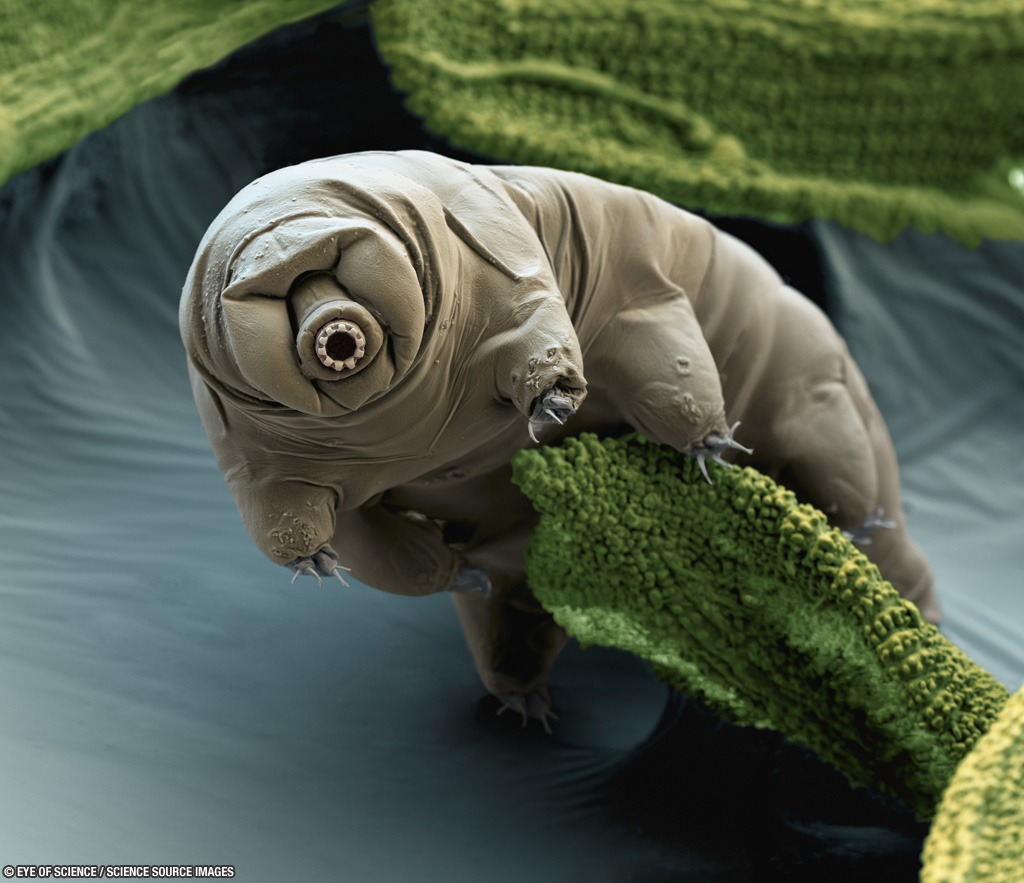
A tardigrade full of eggs.

The tardigrade is an amazing organism with the ability to survive in a multitude of extreme environments. This means it is classified as an extremeophile. The tardigrade can be found in a multitude of locations including:
  • Common backyard moss.
  • Lichens on trees in forests.
  • Hot springs.
  • Salt water tidal pools.
  • Freshwater springs.
  • Antarctica.
  • Petrified wood and amber.
These areas are places where tardigrades can be found in there animated. Tardigrades can be found in numerous even more extreme environments in their dehydrated hibernation state.

Tardigrades are able to undergo a process called cryptobiosis. This means they dehydrate themselves and slow their metabolic rate to nearly nothing. This allows them to survive extreme conditions and wait out droughts and other natural disasters. They can reanimate themselves after any amount of time.

There are a few different kinds of cryptobiosis including:
  • Anhydrobiosis- Extreme form of desiccation. Nearly all water leaves the tardigrades body.
  • Cryobiosis- Occurs when temperatures are very cold. The organism will align water molecules in a certain way inside of its body.
  • Osmobiosis- Occurs when the surrounding water or soil is so salty all water is stripped from the tardigrade.
  • Anoxibiosis- This occurs when the tardigrade is deprived of oxygen. This causes the tardigrade to enter a rigamortis state, freezing the tardigrade in a position.
Life Span-
The tardigrade lives approximately 1 year without any form of cryptobiosis.
The tardigrade lived a maximum of 120 years with cryptobiosis.

How To Harvest Tardigrades-
Tardigrades can be found in most mosses on trees in New Jersey. Mike Shaw, one of Project Stratobear's mentors, researched tardigrades in New Jersey. He concluded they tardigrades can be found in every county.


Tardigrade Summary-
The tardigrade is an extremely interesting and diverse animal. Project Stratobear hopes to support the notion that it may have originated from outer space. This would support the Panspermia Hypothesis, which I will discuss in the following paragraphs.


Panspermia Hypothesis Research:

Basic Summary-
The Panspermia Hypothesis states that life or the building blocks of life can be transferred from one planet to another via asteroids, meteorites, planetoids, and interstellar dust.

What That Means-
That means that either the basic building blocks of life (DNA, proteins, lipids, etc.) or actual life (micro-organisms) can travel from planet to planet via cosmic collisions.

Supporters-
Numerous scientists believe that Panspermia is possible it has never been proven to have actually occurred. A few studies on meteorites showed "proof" of extra terrestrial life, but these studies are poorly documented and many are skeptical of the validity of the statement.

"Life could spread from planet to planet or from stellar system to stellar system, carried on meteors." -Stephen Hawking
Importance to the Space Industry-
Proving or supporting the Panspermia Hypothesis will generate massive public attention to the space industries. Even if this attention is short lived it still will have an impact on space support for emerging companies like SpaceX.


Hull Design Research:

The research to complete this project would be based upon this extremely simple design. This design shows a construction that would complete all specs assuming no limits were in place. From this design the final products research could be conducted, changing different parts to adhere to the limits that Project Stratobear would have. This allows the team to break down the larger system into separate parts for research and refinement.
This is a simple high altitude probe designed to record video of the curvature of Earth. Its main features are a large curved glass window and simplistic design.

Another simple design. This probe carried a Raspberry Pi micro-controller board to measure and record different atmospheric conditions.
This is a Soyuz landing capsule, designed to return cosmonauts and astronauts to Earth from the International Space Station.


This is Strato-Cat a scientific research balloon with a large payload and nearly cubical shape.

Hull Summary
The images above show different designs for hull structures of upper atmospheric and space vehicles. These will be used for inspiration when designing the projects probe. Each vehicle exhibits different properties and benefits to certain missions. Figure one is an enclosed camera used for simple video recording. The figure two is of the Apollo 13 re-entry capsule. This design has a rounded bottom to act as heat shielding.  Figure three shows a micro-controller designed to record atmospheric conditions. Figure four shows a Russian Soyuz landing vehicle. This design incorporates landing legs. The final picture is of a large weather balloon probe designed to record upper atmospheric conditions and film video.


Background Information


Tardigrades- An Opportunity for Discovery 

Tardigrades are an excellent opportunity to unlock the secrets of the cosmos and extraterrestrial biology. Tardigrades are a ubiquitous extremophile found on every continent of Earth. Tardigrades have often been used to support the Panspermia Hypothesis. The Panspermia Hypothesis states that microorganisms or biochemical compounds from outer space are responsible for originating life on Earth and possibly in other parts of the universe where suitable atmospheric conditions exist. Supporting the Panspermia Hypothesis is valuable to science because it will encourage the exploration of space and the quest to discover extraterrestrial life.

The People

The people with interests in Project Stratobear range from astrobiologists, to medical researchers. Astrobiologists are interested because of the application of the project to the Panspermia Hypothesis and furthering their field of studying extra terrestrial life. Another group of people interested in Project Stratobear is amateur scientists. They could possibly inspired by Project Stratobear because it shows you do not need to be a multi-million dollar corporation to carry out scientific research and make discoveries. The medical fields are interested in the project because the cryptobiotic state of the tardigrade can lead to new ways medicinal fields can preserve medications. 
Astrobiology is the study of extra terrestrial life.

A tardigrades cryptobiotic state can possibly be used to preserve medicine.

Leonardo da Vinci a famous amateur scientist dedicated to discovery.

Pharmaceuticals are plagued by short shelf lives of medicine, leading to profit loss.


The Problem or Application

Tardigrades must be researched because of their application to the Panspermia Hypothesis. The project can lead to support of the Panspermia Hypothesis by proving tardigrades are able to survive the atmospheric conditions involved in re-entering the Earth's atmosphere. By supporting the Panspermia Hypothesis we would be encouraging deep space exploration because proof of Panspermia supports the notion of planets with a habitable atmosphere. Also we would be assisting medical fields in preserving medication and extending shelf lives, reducing waste and improving pharmaceuticals.
Weather balloons can discover many statistics about the atmosphere.

Proof of the Panspermia Hypothesis means proof of planets that can sustain life.

Interstellar travel and human colonization can be supported by proof of Panspermia.

The universe is vast. We are merely a speck in the already vast milkyway.

Extra terrestrial life may be as small as microbes.


The Stake Holders

The stake holders in the project are investors and company owners in the fields of space manufacturing and pharmaceuticals. These stake holders would benefit from this project because for space manufactures it would improve the quest for extraterrestrial life and space exploration and pharmaceuticals could improve their products shelf life, therefore reducing profit losses. Both of these industries are important in the modern day however, the space industry could use more popular support from other scientific groups.
The space industry and pharmaceuticals is big business.

Pharmaceutical companies could improve shelf lives of medicine by using cryptobiosis.

Pills are manufactured like any other product. The companies experience losses from expired medicine.

The space industry is a multi-billion dollar manufacturing ordeal. 

SpaceX now paves the way for space travel.


The Mood

The mood of our design project is functionality and discovery. Our probe needs to be functional at recording data and containing the tardigrades. However, the overall "feel" of the project is one of a passion for discovery. The project seeks to uncover the mysteries of one of the most interesting organisms on Earth. The truth about the tardigrade will still be unknown after our project, but we will be that much closer to discovering where it came from and why it is ubiquitous.
The data recorded in the project must be accurate and plentiful.

These chairs show functionality over aesthetics.

Discovery is a goal of Project Stratobear.

The moon walk is an example of a great human discovery and innovation.

Though the cube looks plain, it holds things just as well as a nice looking bag.


Similar Projects and Methods

Similar products to Project Stratobear are quite common. Numerous people do weather balloon tests every year. These tests discover atmospheric conditions in different regions, but they do not often test living organisms within these balloons. Project Stratobear is also similar to running tests on lab rats. By combining these two aspects of science, ballooning and animal testing, we hope to discover more about the tardigrade and the ways it can or cannot survive atmospheric re-entry.
 
This is an example of a compartmentalized box. This is a horizontal compartmentalization while ours is a vertical. 

This tupperware is divided vertically instead of horizontally for separation. Similar to our design this separates the two items. 

This is an arduino board used to record data in a high altitude balloon.

A NOAA balloon recording weather patterns.

Large scale NASA balloon.

Lab rats used in scientific research.

Petri dish of bacteria used for medicinal research.


Closing Words

Project Stratobear is a research project that hopes to solve the mystery of the tardigrade. The project will carry out this research by using a weather balloon launched with a tardigrade payload. The weather balloon will expose the tardigrades to numerous atmospheric conditions that space matter would be exposed to while entering Earth's atmosphere. The probe will also record atmospheric data to determine whether or not the tardigrades survived the flight. The project hopes to spur interest and advance in numerous fields. Pharmaceuticals and space manufacturing being the main fields. The space industry would be improved by support of the Panspermia Hypothesis, because it would show there are other habitable planets in the universe, while the pharmaceutical industry would be improved by further research on the tardigrade's cryptobiotic ability because it would allow shelf lives of medicine to be improved.

Alternate Solutions

Compact Rectangular Probe

This design titled "Compact Rectangular Probe" features the vertical divider that separates the two compartments. This means the left compartment contains the Tardigrade samples while the right contains the electronic equipment. The exterior walls of this design would be made with Styrofoam insulation. The divider would be constructed from a sheet of plexi-glass. The eyelet which would attach the balloon is attached to the plexi-glass divider. On the top of the probe would be two access panels allowing the insertion of electronic equipment as well as Tardigrade petri dishes. This probe is the only design that uses a vertical divider instead of a horizontal one. The materials used in the construction of this probe would be plexi-glass for the divider, styrofoam for the walls, and aluminium for the eyelet. The benefits of this design are the extremely simple construction, the small amount of materials needed, and the lightweight design.


Soyuz Style Probe

This probe design is modeled after the Soyuz landing craft. The Soyuz landing craft is used by astronauts and cosmonauts returning from the international space station. This is the only design featuring the landing legs. This design has a vertical division between the two compartments. Another feature is that the bottom of the probe has hinges which allow it to swing open for the insertion of a tray of petri dishes. This allows the user to insert all of the dishes at once and therefore reduce the risk of spilling them. The legs would assist Nathaniel Librizzi in his goal of a soft landing upon re-entry of the probe.


Triangular Probe

The third probe design uses the idea that triangles are the strongest shape in nature. This design also allows the user to cut down on weight because of the fact there is less wasted space for the electronic equipment. This means that the larger bottom compartment is able to hold an equal amount of tardigrades. The bottom tardigrade containment layer contains a checkerboard pattern to hold the petri dishes in place. There are side access panels to get into the electronics and tardigrade areas.


Mesh Exposure Probe

The third probe design was a combination of both the Soyuz Probe's shape, and the Compact Rectangular Probe's simplicity. The design features a vertical division between the electronic components and the tardigrade storage area. The top of the probe is reinforced with a plexi-glass circle to prevent the eyelet from ripping itself free. The tardigrade containment area is made from mesh that allows the atmospheric conditions to effect the tardigrades within. This probe once again features a checkerboard pattern that


Summation Abstract-
Each idea exhibits a different feature. The feature in the first design is the extreme simplicity of construction. This means it is very easy to produce, but may not yield the best results. This is because the exposure area is not as exposed as some of the other designs. The second probe "Soyuz Style" is the safest in regards to landing however it will be heavier than necessary due to the large landing legs. The third design is triangular which means it will have a large amount of strength compared to the other designs. However this design compromises the area available for electronics and cameras. The final design is harder to build but yields the greatest exposure for the tardigrade storage as well as the largest area for cameras and electronics.